Key Takeaways
- Shipping: Orders shipped from inside the EU to an EU address arrive without customs charges, while parcels from outside the EU can bring extra fees and delays.
- Proof: Look for a lab report for the batch on sale, showing its grayanotoxin content.
- Origin: A trustworthy seller names the region the honey comes from.
- Label: Look for a clear maximum amount and who mad honey isn't recommended for.
- Honesty: Be wary of any seller who makes health claims or promises the "strongest" jar on the market.
Search for mad honey online, and you'll find web shops and marketplaces selling jars that look almost identical. Some come with batch lab reports and a named origin. Others come with a nice photo of a mountain and very little else.
Before you order, check where the seller ships from, whether the batch on sale has a published grayanotoxin lab report, where the honey comes from and what the label says. A good seller also has a clear returns policy and real contact details. If any of those are missing, keep looking.
How Shipping Affects Your Mad Honey Order
Where your parcel starts its journey affects the price you pay, how long you wait and the condition your honey arrives in.
Ordering From a Seller Inside the EU
When a seller ships from inside the EU to an address inside the EU, there are no import duties or customs charges to pay on delivery. The price at checkout is the price you pay, and parcels usually move faster because they don't sit in a customs queue.
We ship from within the EU. Delivery times per country are on our shipping page.

Ordering From Outside the EU
Parcels from outside the EU are a different story. Since 2021, VAT applies to goods imported into the EU regardless of their value, and some couriers add a handling fee on top. Honey is also an animal product, so shipments from outside the EU may be checked against EU food import rules. That can mean delays, and in some cases a parcel may be held or sent back.
None of this makes ordering from outside the EU impossible, but it's worth knowing before you pay. A cheap jar can end up costing quite a lot once fees are added.
Heat in Transit
Like any raw honey, mad honey is best kept below 40 °C, and delivery vans and parcel lockers can get hot in summer. A careful seller packs honey well and ships it quickly.
Why Batch Lab Reports Matter When Buying Mad Honey
Mad honey is a wild product, and its grayanotoxin content changes from harvest to harvest. Two jars with the same label can come from very different harvests, and the only way to know what's in a batch is lab testing.
What a Batch Lab Report Should Show
A proper lab report belongs to one specific batch. It shows the grayanotoxin content measured in that batch, usually listed as GTX I and GTX III, and the seller should be able to tell you which report applies to the jar you buy.
Every batch of Real Mad Honey is tested by an independent laboratory for its grayanotoxin content. On our Lab Report page you can look up the report that applies to your order.

Why "Lab Tested" Isn't Enough
Plenty of product pages say "lab tested" with a small badge and nothing behind it. A badge doesn't show which batch was tested, what was measured or what the results were.
If you can't find a report, ask the seller for one before you order. A seller who tests their honey will usually be glad to show you the results. A vague answer, or a single report that covers "all our honey", tells you what you need to know.
Mad Honey Seller Checklist
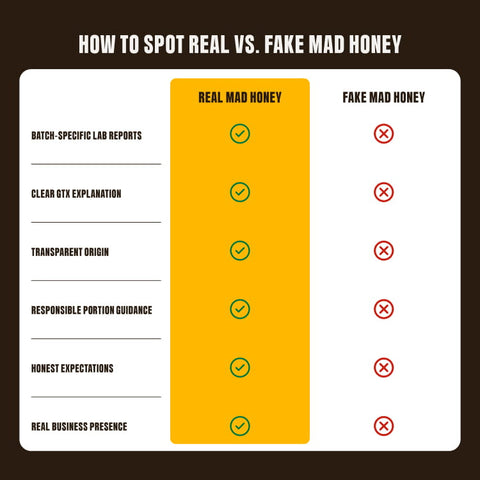
The way a seller talks about mad honey tells you a lot. An honest seller describes it as what it is: a food with a named origin, a lab report for each batch and clear label information.
Origin matters too. A trustworthy seller names the region their honey comes from, not just "the Himalayas" or "wild mountains", and can explain how their mad honey is sourced. Published sourcing and batch testing are the main reasons people trust Real Mad Honey, and they're fair questions to ask any seller.
| What to check before buying mad honey online | What a trustworthy seller offers | Red flags |
|---|---|---|
| Countries delivered to | A clear list of the countries the seller delivers to | No information on where they deliver |
| Where the mad honey ships from | A stated shipping origin and clear information on customs fees | No shipping origin, or surprise fees on delivery |
| Batch lab reports | A report for every batch, showing its grayanotoxin content | A "lab tested" badge with no report behind it |
| Origin of the mad honey | A named region in Nepal or Turkey | Vague claims like "wild Himalayan honey" |
| Label information | A clear maximum amount and who the honey isn't recommended for | No limit stated, or advice to eat large amounts |
| Health claims | No health claims of any kind | Promises about health |
| How the honey is described | Origin, harvest and taste | "Strongest ever" promises or drug-culture language |
| Returns policy | A written returns policy you can find before you buy | No returns policy, or one you can't easily find |
| Payment and contact details | Secure checkout, a real email address and a business address | Payment by bank transfer only, with no way to reach the seller |
Label Information
Never more than 5 g a day – less than one level teaspoon, for adults only.
Eating more than 5 g a day can cause dizziness, nausea, cold sweats and low blood pressure. If that happens, stop, drink water and rest; if symptoms are severe, call 112 or see a doctor. Not recommended for children, during pregnancy or breastfeeding, for people with heart or blood pressure conditions, or if allergic to honey. Taking medication? Ask your doctor first.
Final Thoughts
Buying mad honey online in Europe is easy. Making sure you get tested honey from a seller you can trust takes a few minutes more: find out where the seller ships from, look for a lab report for the batch you're buying and read the label information. The seller's tone tells you almost as much as their test results.