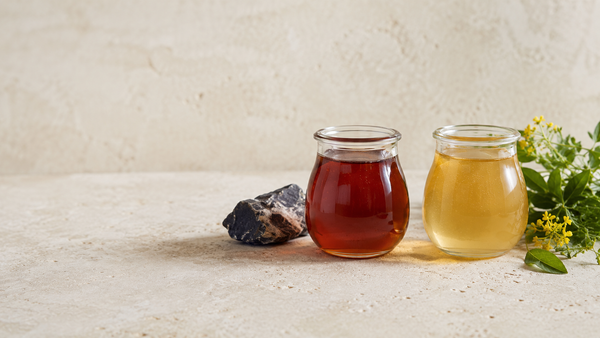
Nepalese mad honey is the benchmark the rest of the category is measured against. It comes from the highest cliffs in the Himalayas, from the largest honey bee on earth, and from a harvest that has never been mechanized or farmed in any form.
That combination is why Nepal dominates the conversation around mad honey, and why the honey carries the reputation for strength it does. What follows is where that reputation comes from, how much of it holds up against laboratory figures, and where the honey sits alongside the other origin worth knowing about.
Nepal's Place in Mad Honey
Mad honey reaches the market from two regions: the Himalayan belt through Nepal, and the Black Sea coast of Turkey. Grayanotoxin-bearing plants grow more widely than that, including elsewhere in the Himalayas and in parts of North America, but nowhere else produces honey from them at commercial scale.
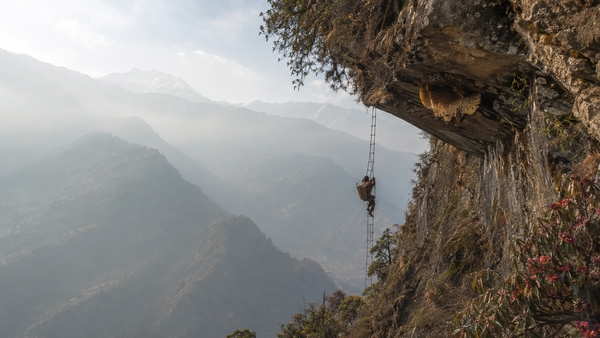
Nepal nonetheless became the reference point, and the reason is the harvest rather than the honey. Turkish deli bal is produced by beekeepers with managed hives in mountain meadows. Nepalese mad honey is taken from wild colonies on vertical cliff faces by hunters descending on handmade rope ladders, a practice that has been filmed, documented, and written about repeatedly, and which no other honey in the world requires.
Reputation and measured potency are not the same thing, and the second half of this article deals with what testing actually shows. What is not in dispute is that the Nepalese harvest is the rarer, harder, and more dangerous of the two, and that the honey it produces is the one most buyers mean when they say mad honey.

What Makes Himalayan Honey Different
Three things separate Himalayan honey from mad honey produced anywhere else: the altitude, the bee that works it, and the plants growing there. Altitude comes first because it governs the other two, since only one bee species forages that high and only at those elevations do rhododendrons crowd out most of what else is in bloom.
The colonies that produce Nepalese mad honey sit between roughly 2,500 and 3,500 meters, and the bees forage higher still, up to around 4,100 meters. At those elevations, the plant community narrows sharply, and rhododendrons make up a far greater share of what is available to a foraging colony than they would lower down.
That concentration is what matters. Grayanotoxins reach honey only when bees work grayanotoxin-bearing rhododendrons heavily rather than incidentally, and a high Himalayan slope in spring offers little else. The same species growing in a mixed lowland forest, competing with everything else in bloom, produces honey with traces of the compounds and no noticeable effect.
Isolation compounds it. These are not hives placed near a crop and moved on afterwards but permanent wild colonies in terrain that cannot be reached by road, which means the honey reflects whatever grew within flying distance of a particular cliff during a particular spring. A fuller account of what mad honey is and why its composition varies covers the chemistry behind that.
The Bees That Make Nepalese Mad Honey
The bee behind Nepalese mad honey is Apis laboriosa, the Himalayan giant honey bee, a different species from the one behind Turkish honey and the reason the Nepalese harvest cannot be industrialized.
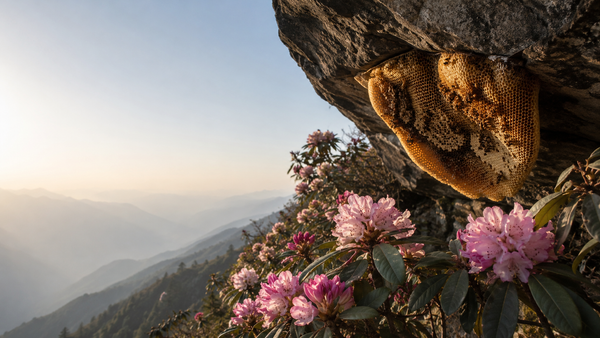
Apis laboriosa is the largest honey bee in the world. Workers reach roughly 2.8 to 3 centimeters, close to twice the length of the European honey bee that produces almost all commercial honey, including deli bal. It builds single enormous combs in the open air, beneath overhangs on cliffs facing south or south-west, where the rock holds warmth and shelters the colony from wind.
The decisive fact is that it cannot be kept. Every attempt to move these colonies into conventional hives has failed, because the species did not evolve to nest in enclosed spaces and abandons any structure it is put into. There is no version of Nepalese mad honey that comes from a managed apiary, and there never has been. Every jar traces back to a wild colony that chose its own cliff.
One clarification worth making, since it is widely muddled. The bee does not create the grayanotoxins and does not make the honey strong. The flowers do that. What the bee determines is where the honey can come from at all, since only this species works those altitudes, and what it costs, since reaching those combs requires people rather than equipment.

The Himalayan Rhododendrons
Nepal has around thirty rhododendron species, and Rhododendron arboreum is the one most associated with mad honey. It is the national flower, which grows as a tree rather than a shrub across broad elevation bands, and it flowers in a burst through the spring months.
Nepalese honey is rarely the product of one species alone. Pollen studies of Nepalese mad honey consistently find the samples to be multifloral, with rhododendron pollen dominant in many but rarely alone. Himalayan colonies forage across a wide range of altitudes and plant communities, and what reaches a comb reflects everything that happened to be in bloom within range.
That variability is a feature of a wild product rather than a fault in it. A honey that recorded exactly one species every year would be describing a managed crop, not a mountain, which is why two Nepalese harvests from adjacent valleys can differ noticeably in color, flavor, and strength.
How Mad Honey Is Harvested in Nepal
Mad honey is harvested by hand from wild cliff colonies, twice a year at most, by teams working on rope ladders. The main collection falls in April and May when the rhododendrons are in full bloom, and this is the harvest that produces the strongest honey. A second, smaller one sometimes follows in October and November, by which point the rhododendrons have finished, and the colonies have been working a broader mix, which generally yields a milder jar.
The method has barely changed. A team of ten to fifteen people works a single cliff, some handling ropes from above, one or two descending on a handwoven ladder to the comb itself, and others below collecting sections in baskets. Smoke is used to move the bees off the comb, and in many communities it also carries ceremonial weight, offered before the harvest begins. The nests sit twenty-five meters or more above the valley floor, and the work is done without harnesses or modern climbing equipment.
Nothing about this scales. The number of accessible cliffs is fixed, the flowering window is short, and the number of people willing and able to do the work is falling as younger generations move to cities. The full account of how the honey reaches the jar covers the tradition in more depth, and it explains the price of the finished product more convincingly than any other single factor.
Nepalese vs Turkish Mad Honey
Nepalese and Turkish mad honey differ in bee, method, flavor, and strength, and the differences run deeper than taste alone.
| Nepalese | Turkish | |
|---|---|---|
| Bee | Apis laboriosa, wild | Apis mellifera, managed hives |
| Harvest | Cliff colonies, by rope ladder | Mountain meadows, by beekeepers |
| Rhododendrons | R. arboreum and local species | R. ponticum and R. luteum |
| Color and taste | Dark, earthy, bitter | Lighter, smoother, milder |
| Typical strength | Generally the stronger | Generally the gentler |
| Best for | The fullest character | A first jar |
Turkish deli bal comes from the Kaçkar mountains and the wider Black Sea region, where Rhododendron ponticum and Rhododendron luteum grow in dense stands across forested slopes. Beekeepers move managed Apis mellifera hives into high meadows during the flowering period, which is small-scale pastoral beekeeping rather than honey hunting. The resulting honey is typically lighter in color, smoother, less bitter, and gentler in effect.
Nepalese honey is the darker, earthier, and generally stronger of the two, with a heavier character that suits anyone wanting the fullest version of what mad honey does. Turkish honey is the easier introduction, and a reasonable first purchase for anyone who has not tried either.
Neither is a fixed quantity, and this is the point most comparisons miss. A strong Turkish harvest can outperform a mild Nepalese one, because both vary by season, altitude and flowering conditions. Origin sets an expectation of character. The batch decides the actual strength.
What the Lab Reports Show
Laboratory testing measures grayanotoxin content as figures for GTX I and GTX III, and those numbers are the only objective statement of strength that exists. What they consistently confirm is that properly sourced Himalayan honey sits at the potent end of the category, which is what the altitude, the bees, and the flowering conditions would predict.
They also expose the gap between good sourcing and bad. A study of sixty samples sold as Nepalese mad honey found measurable grayanotoxin in only thirty-three of them, which says nothing about Nepal and a great deal about how much honey carries the name without earning it. The region produces the strongest mad honey in the world and the largest volume of imitations, for the same reason: it is the name buyers look for.
That is why the report matters as much as the origin. A tested Nepalese jar is the strongest thing available in this category. An untested one is a name on a label, and the difference between them cannot be seen, tasted, or inferred from price.

Where to Buy Nepalese Mad Honey
Specialist importers rather than shops sell Nepalese mad honey, which makes the seller a more important decision than the region on the label. Four things separate a credible source from the rest:
-
A named harvesting area rather than a country
-
Laboratory results published against the batch actually on sale
-
Serving guidance conservative enough to suggest the honey works
-
A business with contact details and a returns policy behind it
Real Mad Honey sources Nepalese honey wild-harvested above 3,500 meters through established Himalayan honey-hunting communities, and Turkish honey from the Black Sea region for anyone wanting the gentler profile. Every batch is analyzed by Eurofins for GTX I and GTX III before sale, with the report published for the batch on the shelf, and batches falling outside the accepted standards are rejected rather than blended or discounted.
Jars run from 50g to 500g, shipping goes out from the Netherlands with no customs charges within the EU, and a 60-day guarantee covers unopened returns. Each harvest keeps its own character rather than being presented as identical to the last, which is the only honest way to sell a wild seasonal product.
Conclusion: Choosing Nepalese Mad Honey
Everything that gives Nepalese mad honey its standing is a matter of geography and biology rather than positioning. It comes from the only bee that works those altitudes, from rhododendrons growing where little else competes with them, and from a harvest that cannot be scaled, farmed, or hurried. Nothing about that is marketing.
What it does not come with is a guaranteed number. Strength varies between valleys, between seasons and between individual harvests, and the honest position is that Nepalese origin makes a potent jar likely rather than certain.
That leaves the decision in a sensible place. Origin sets the character, with Nepalese honey offering depth and Turkish honey a gentler introduction, and the batch report confirms what is actually in the jar. Reputation is a reliable guide to what to expect. The figures are what settle it.