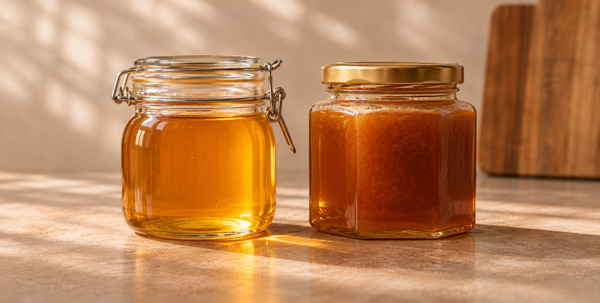
- Bees make honey from flower nectar, not from pollen.
- Enzymes from the bees break down the sugars in nectar and change it into honey.
- Bees fan the stored nectar with their wings until most of the water evaporates.
- Mad honey is made the same way, but from rhododendron nectar.
A spoonful of honey is the result of thousands of flower visits, a chain of bees passing nectar from one to the next and days of careful drying inside the hive.
This guide explains how honey is made step by step, from the moment a bee lands on a flower to the moment a beekeeper fills a jar. It ends with mad honey, which bees make in the same way as any other honey, only from a very different kind of flower.
How Do Bees Make Honey?
Bees make honey by collecting nectar from flowers and turning it into honey inside the hive. Forager bees drink nectar and carry it home in a special stomach, where enzymes start breaking down its sugars. Back at the hive, they pass the nectar to younger house bees, who add more enzymes and store it in wax cells. The bees then fan their wings to evaporate the water until the nectar becomes thick honey. Finally, they seal each full cell with a cap of beeswax, which keeps the honey stored until the colony needs it.
Which Bees Make Honey in a Colony
A honey bee colony works like a small, well-organised town. Worker bees do almost all the work. These are the female bees that make up most of the colony. The queen lays eggs and the male drones mate with queens from other colonies, but neither makes honey.
What a worker bee does depends mostly on her age. Young workers stay inside the hive. They clean cells, feed the larvae, build comb from wax and take in nectar from returning foragers. These are often called house bees. Older workers, usually from around three weeks old, leave the hive to collect nectar, pollen, water and plant resin. These are the foragers.
Honey making relies on both groups working together. The foragers bring in the raw material, and the house bees turn it into honey and store it. This division of work is a big part of why bees make honey so efficiently.
How Bees Make Honey, Starting With Foraging for Nectar
Everything starts with nectar, the sugary liquid that flowers produce to attract pollinators. Nectar is mostly water with dissolved sugars, mainly sucrose, glucose and fructose, plus small amounts of other natural compounds from the plant. How much sugar it contains varies a lot from one flower to the next, but it's always far runnier than honey.
How Bees Find Flowers
Foragers find flowers by colour and scent. Bees see colours differently from people, including ultraviolet patterns on petals that guide them towards the nectar. A good scent trail can also lead them in from a distance.
Once a forager finds a rich flower patch, she can share the location with her sisters. Back in the hive, she performs what's known as the waggle dance, running in a straight line while shaking her body, then circling back and repeating it. The angle of the run shows the direction of the flowers in relation to the sun, and the length of the waggle shows roughly how far away they are. Other foragers follow the dance and then fly out to the same spot.
Carrying Nectar Back to the Hive
At each flower, the bee reaches in with her proboscis, a long, tube-like tongue, and sucks up the nectar. She doesn't swallow it into her digestive stomach. Instead, it goes into her honey stomach, also called the crop, a separate pouch she uses for carrying liquid back to the hive.
Filling the honey stomach takes a lot of flowers. A forager often visits dozens of flowers on a single trip, and a full load can weigh a large share of her own body weight. She then flies home, sometimes from a few kilometres away, and does it again, multiple times a day.
By the time she lands, the change from nectar to honey has already begun. Glands in her body add enzymes to the nectar while it's still in her honey stomach.
Turning Nectar Into Honey With Enzymes
The key difference between nectar and honey isn't only how thick they are. It's also what's happened to the sugars. Bees change those sugars using enzymes, natural proteins that speed up chemical reactions.
The most important one is invertase. It splits sucrose, the main sugar in many nectars, into two simpler sugars, glucose and fructose. Honey is mostly made of these two sugars, which is why it tastes and behaves differently from a sugar solution. The balance between glucose and fructose also decides how quickly a honey crystallises later on, since glucose is the sugar that forms crystals.
A second enzyme, glucose oxidase, turns a small amount of glucose into gluconic acid. This gives honey its slightly acidic character and helps it keep for a long time without spoiling. Bees add other enzymes too, in smaller amounts.
When a forager gets back to the hive, she doesn't put the nectar straight into a cell. She passes it mouth-to-mouth to a house bee, which takes the nectar into her own honey stomach. The house bee may hold it for a while, adding more enzymes, and then pass it on to another bee or deposit it in a cell. This passing from bee to bee mixes in more enzymes and starts drying the nectar, since a thin film is exposed to the warm air of the hive each time.
How Bees Dry Nectar Into Honey
At this point, the nectar is changing chemically, but it still holds too much water. Left that way, it would ferment. The next stage of how bees make honey is all about drying it out.
House bees place the nectar into the hexagonal wax cells of the comb. Often they spread it in a thin layer at first or hang small droplets on the cell walls, so more of the surface is exposed to air. Then the colony starts fanning. Rows of bees stand on the comb and at the hive entrance, beating their wings to keep air moving through the hive. Warm, damp air is pushed out, and drier air is pulled in, so the water slowly evaporates from the nectar.
You can sometimes hear this stage of the process: on a warm evening during a heavy nectar flow, a hive can hum loudly as the bees fan through the night.
The inside of a busy hive stays warm, at around 35 °C near the brood, which helps the water evaporate faster. Over several days, sometimes longer, the nectar thickens into honey. By the end, the water content has dropped to around 17 to 18 per cent, a fraction of what it was when the nectar left the flower.
This low water content is what makes honey last. With so little water and so much sugar, the honey is too concentrated for yeasts to grow, so it doesn't ferment.
Sealing Honey in Beeswax
When the honey in a cell is thick enough, the bees seal it with a thin cap of fresh beeswax. This keeps the honey clean and stops it from absorbing moisture from the air.
Bees make the wax too. Young worker bees, usually a couple of weeks old, have wax glands on the underside of the abdomen. After eating honey, they produce small, clear flakes of wax from these glands. Other bees chew and shape the flakes, then use them to build new combs and to cap finished cells. Making wax takes a lot of energy, and bees use up a good amount of honey to produce it.
For beekeepers, the wax caps are a useful signal. A frame where most of the cells are capped is a frame of finished, ripe honey. Honey taken before it's capped may still hold too much water.

How Much Work Goes Into Making Honey
The numbers behind honey making are often quoted to show just how much work goes into it. They vary from source to source and depend on the flowers, the weather and the colony, so treat them as rough figures.
A single worker bee is commonly said to make only about a twelfth of a teaspoon of honey in her whole life. Foragers live just a few weeks in summer, and they spend much of that time flying. To make one jar, a colony is often said to need millions of flower visits and flights that add up to multiple trips around the world.
With plenty of flowers nearby, a colony can store far more honey than it needs, which is what makes beekeeping possible. The bees make it to get through times when there are no flowers, such as winter or long dry spells. A beekeeper takes the surplus and leaves the colony enough to live on.
From Comb to Jar: How Beekeepers Collect Honey
Once the bees have done their part, the beekeeper takes over. How honey gets from the comb to the jar is fairly simple, and many small beekeepers still do most of it by hand.
Taking the Frames From the Hive
Most hives today are built with removable wooden frames, each holding a sheet of comb. When enough of the comb is capped, the beekeeper opens the hive, gently clears the bees off the frames and carries the frames away to be processed. The honey usually comes from boxes placed above the main brood area, so the beekeeper can take honey without disturbing the young bees.
Uncapping and Spinning Out the Honey
The wax caps have to come off first. The beekeeper slices them away with a heated knife or scrapes them open with a fork-like tool. The wax cappings are kept and later melted down into beeswax.
The uncapped frames go into an extractor, a drum that spins the frames quickly. The spinning throws the honey out of the cells, and it runs down the sides of the drum and collects at the bottom. Because the comb stays mostly intact, the beekeeper can put the empty frames back in the hive for the bees to refill, which saves them a lot of wax-making work.
Some honey is sold still in the comb, without extraction. Comb honey is simply cut into pieces and packed as it is, wax and all.
Straining and Settling
Fresh honey from the extractor contains bits of wax and sometimes the odd bee part. The beekeeper pours it through a mesh strainer to catch these. The honey is then left to stand in a settling tank for a few days, so that tiny air bubbles and fine wax particles rise to the top and can be skimmed off.
Filling the Jar
After settling, the honey is poured into jars, often straight from a tap at the bottom of the tank. Small producers usually jar it as it is. Larger packers may also warm and finely filter honey before bottling, which keeps it clear and runny for longer.
How Flowers Change the Honey Bees Make
Every honey is made through the same process, but no two kinds taste the same. That's because the flowers the bees visit decide what goes into the nectar in the first place.
Acacia nectar gives a pale, delicate honey that stays runny for a long time. Chestnut and heather give dark, bitter or malty honeys. Rapeseed honey sets quickly into a firm white block. The bees handle each nectar in exactly the same way, but the plant's sugars, colour compounds and aromas pass into the honey and give each one its own character, including its colour, flavour and texture.
This is also how mad honey comes about. It's ordinary honey making, with an unusual flower at the start of it.
How Bees Make Mad Honey
Mad honey is made by honey bees following the same steps we described above: foraging, adding enzymes, fanning away the water and capping the honey in wax. What makes it different is the nectar the bees collect and, in Nepal, the bees themselves and where they build their nests.
Rhododendron Nectar
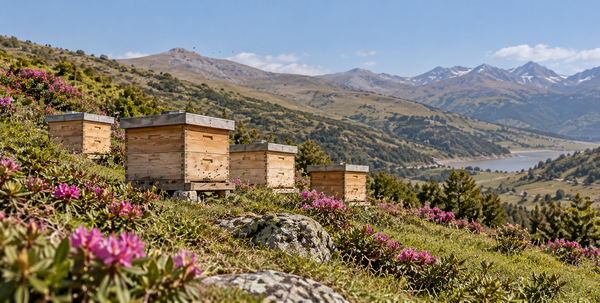
Mad honey comes mainly from the nectar of certain wild rhododendrons that grow in large numbers in two mountain regions. In Turkey, these are Rhododendron ponticum and Rhododendron luteum in the forests above the eastern Black Sea coast. In Nepal, they're Himalayan species such as the tree rhododendron, Rhododendron arboreum.
Because the bees make honey from this nectar, mad honey contains naturally occurring grayanotoxins from rhododendron nectar. The bees also visit other flowers blooming at the same time, so each harvest carries a mix of nectars, with rhododendron as the main one.

Himalayan Giant Honey Bees on Nepal's Cliffs
In Nepal, mad honey is made by the Himalayan giant honey bee, Apis laboriosa. Unlike hive bees, these bees live in the open. Each colony builds a single, large comb hanging under an overhang on a high cliff, often with several other colonies nesting on the same rock face.
The steps of honey making are the same, but they happen outdoors. Foragers collect nectar from the rhododendron forests below the cliffs. House bees process it on the open comb, and the colony fans it dry while clinging together in a thick curtain of bees that covers the comb. The honey is stored in the upper part of the comb, close to where it attaches to the rock, while the young bees are raised lower down.
Hive Bees on Turkey's Black Sea Coast
In Turkey, mad honey, known as deli bal, is made by European honey bees in managed hives. Beekeepers place their hives in the Kaçkar Mountains above Rize and Artvin, among the rhododendrons, during the flowering season from around April to June.
Here, the honey is made exactly as described in the first part of this guide. The bees forage in the surrounding forests, process the nectar inside wooden hives, fan it dry and cap it in the wax frames. The beekeepers take it out once it's ready.
Collecting the honey is the final step, and it looks very different in the two regions, from rope ladders on Himalayan cliffs to frames lifted from hives in Turkey.
Final Thoughts
Honey is the result of bees turning a short-lived resource into food that lasts. Foragers gather nectar from flowers and house bees add enzymes as they pass it along. The whole colony then fans it until it's thick enough to keep and seals it under wax. Beekeepers take the surplus, spin it out of the comb, strain it and jar it. Mad honey goes through the same process. The difference is the rhododendron nectar at the start and, in Nepal, the giant bees that make it on open cliff faces.
Label information
Never more than 5 g a day – less than one level teaspoon, for adults only.
Eating more than 5 g a day can cause dizziness, nausea, cold sweats and low blood pressure. If that happens, stop, drink water and rest; if symptoms are severe, call 112 or see a doctor. Not recommended for children, during pregnancy or breastfeeding, for people with heart or blood pressure conditions, or if allergic to honey. Taking medication? Ask your doctor first.
This is a serving guideline for Real Mad Honey.