For anyone approaching mad honey for the first time, the Turkish version is usually the easier introduction. Lighter, sweeter and gentler than the Himalayan alternative, it offers the same compounds in a form that is considerably less demanding on the palate.
What is Turkish mad honey?
Turkish mad honey is honey produced by bees foraging on Rhododendron ponticum and Rhododendron luteum, two species that grow in dense stands along the Black Sea coast and whose nectar contains grayanotoxins.
The name it goes by locally is deli bal, which translates roughly as mad or crazy honey. It has been produced, traded, and consumed in the region for well over two thousand years, and it is sold openly in Turkish markets rather than treated as anything unusual.
What separates it from the Nepalese version comes down to three things:
-
The bee, which is the ordinary European honey bee rather than the Himalayan giant
-
The flowers, which grow in dense, continuous stands rather than scattered across alpine slopes
-
The method, which is conventional beekeeping rather than cliff harvesting
You can read more about what mad honey is and the compounds behind its effects.
Where in Turkey does mad honey come from?
Turkish mad honey comes from the Black Sea region in the north-east of the country, particularly through the Kaçkar mountains and the provinces around Rize, Trabzon and Artvin.
The climate there is unusually wet for Turkey, with high rainfall and persistent humidity, which is exactly what Rhododendron ponticum and luteum need to spread. They grow so thickly across the forested slopes that they crowd out most of what else would flower nearby.
That density is what makes the region productive. Where Himalayan honey depends on altitude thinning the plant community, Turkish honey depends on the rhododendrons simply outnumbering everything else within a colony's foraging range.
The history is longer here than anywhere else. Greek soldiers under Xenophon were incapacitated by local honey in 401 BC during their retreat through the region, which is the earliest written account of mad honey and the origin of much of its later reputation. Where mad honey comes from covers both producing regions.
How strong is Turkish mad honey?
Turkish mad honey is gentler than the Himalayan version, which is what makes it the more approachable of the two rather than a weaker product.
A conventional teaspoon produces the same effects in the same order, meaning warmth through the chest, physical relaxation and a slower mental pace, with the difference being one of degree rather than of kind. The arrival tends to be smoother and the peak less pronounced.
Strength still varies between harvests. Grayanotoxin concentration depends on:
-
How densely the rhododendrons flowered that season
-
Where the hives were placed relative to the stands
-
The weather across the flowering window
-
Whether other plants were in bloom nearby
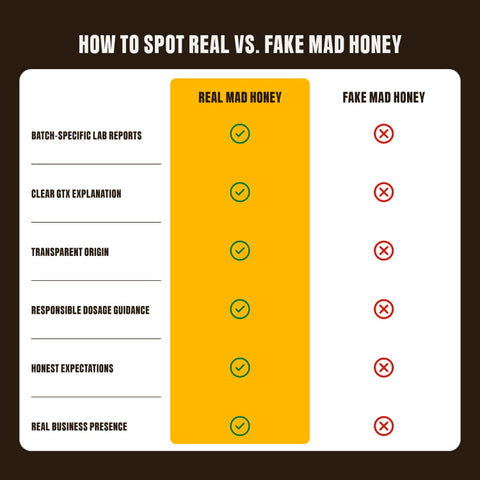
Turkish honey does vary less than Nepalese honey does, since the bees work a narrower range of plants, though the difference is one of degree and no origin removes the need to check the batch. A published laboratory figure remains the only thing that establishes what a particular jar contains.
How is mad honey harvested in Turkey?
Turkish mad honey is collected through conventional beekeeping, with hives moved into high meadows for the flowering season and frames taken in the ordinary way.
The beekeeping year runs roughly as follows:
-
Hives are prepared and inspected ahead of the flowering window.
-
Colonies are transported up to meadows where the rhododendrons grow thickly.
-
Bees forage through the bloom, typically from late spring into early summer.
-
Frames are collected once the honey is capped.
-
The honey is extracted, strained, and jarred.
-
Hives are moved back down or relocated for later forage.
Nothing about it involves ropes or cliffs. The work is skilled but conventional, and it is usually done by families who have kept bees in the same valleys for generations.
The practical consequence is supply. Turkish production is more predictable than the Himalayan harvest, since the process is repeatable and the flowering window is longer, which is why Turkish honey is generally easier to obtain across the year.
What does Turkish mad honey taste like?
Turkish mad honey tastes lighter and sweeter than the Himalayan version, with a floral character and a mild bitterness that arrives well behind the sweetness.
The usual sequence is:
-
First: clear sweetness, closer to a conventional honey
-
Then: a floral, faintly herbal depth
-
After: mild bitterness building gently rather than sharply
-
Finally: a slight tingling at the back of the throat
It runs pale gold to light amber in color and pours more freely than Nepalese honey, which is thicker and darker. Crystallization occurs more slowly, though it still happens and indicates nothing about quality.
For anyone who has found the Himalayan version too bitter, Turkish honey addresses that directly. It is also easier to take on its own rather than needing something to follow it, which suits a first jar.
Where to buy Turkish mad honey?
Turkish honey is easier to find than the Himalayan version, which means more sellers and more variation in what they can tell you. Worth confirming:
-
Which part of the Black Sea region the honey came from
-
Whether the laboratory figures relate to the current harvest
-
How the seller describes the strength, since overstatement is common
-
Whether serving guidance is included with the jar
-
What the return terms are if the honey is not what you expected
Real Mad Honey sources Turkish honey from small family producers along the Black Sea and carries the Nepalese version alongside it, which allows the two to be compared directly rather than one at a time.
Each harvest goes to an independent laboratory before it is offered, and the resulting figures are published alongside the jar they belong to. Jars run from 50g to 500g, orders ship from the Netherlands with no customs charges within the EU, and a 60-day guarantee covers unopened returns.
Choosing a Turkish mad honey
Turkish honey suits the person approaching mad honey for the first time, and it suits anyone who wants the effects without the bitterness the Himalayan version carries.
A small jar is the sensible starting point. It establishes how a particular batch behaves at a conservative serving, and it costs considerably less than finding the same thing out through a larger one.
If you are curious about the difference between the two origins, buying a small jar of each is cheaper than committing to one and discovering the preference afterward.
See the current Turkish and Nepalese harvests to compare what is available now.