Key Takeaways
- A mad honey lab report shows the grayanotoxin content of a tested batch, usually listed as GTX I and GTX III.
- GTX I and GTX III are two of the naturally occurring grayanotoxins coming from rhododendron nectar.
- A useful report names the laboratory, the test date, and the honey it applies to, and gives actual measured values.
- Results differ from batch to batch because the rhododendron species, altitude, and season all vary.
Most honey is sold without any lab paperwork at all. Mad honey is different. Because it contains naturally occurring grayanotoxins from rhododendron nectar, and the amount varies from one harvest to the next, many sellers publish lab reports showing what was measured in each batch.
But a lab report is a technical document full of units and scientific language. This guide explains what's on a typical mad honey lab report, what GTX I and GTX III mean, and how to make sense of the numbers.
What Does a Mad Honey Lab Report Show?
A mad honey lab report shows how much grayanotoxin was measured in a specific batch of honey, usually broken down into GTX I and GTX III. It also lists the laboratory that ran the test, the date of testing, and the sample the results apply to.
What Are GTX I and GTX III?
Grayanotoxins are a group of natural compounds found in the nectar of certain rhododendron species. When bees make honey from that nectar, the compounds end up in the honey too. That's what makes mad honey different from other rhododendron honeys and from everyday varieties like acacia.
There are several different grayanotoxins, and scientists number them with Roman numerals. GTX is simply the short form of "grayanotoxin", so GTX I means "grayanotoxin I" and GTX III means "grayanotoxin III". These two are the ones most often measured when honey is tested, which is why they're the headline figures on most mad honey lab reports.
The two are listed separately because they're distinct compounds, and a lab measures each one on its own. A report showing both gives a fuller picture of the batch than a single combined figure would.
How to Read a Mad Honey Lab Report
Most mad honey lab reports contain the same core sections. Here's what each one tells you.
The Laboratory
The report should name the laboratory that carried out the test, along with its contact details and, often, its accreditation details. An independent lab, one that isn't owned by the seller, gives the results more weight. If there's no lab name at all, you have no way of knowing where the figures came from.
The Test Date
Every report should show when the honey was tested. Because grayanotoxin content changes from harvest to harvest, a recent report tells you much more about what's currently on sale than one from several years ago.
The Sample and Origin
This section tells you which honey the results apply to. For mad honey, that usually means the origin, such as Nepal or Turkey, and sometimes the harvest period.
The GTX I and GTX III Results
This is the main part of the report. Each grayanotoxin is listed with a measured value and a unit next to it, such as milligrams per kilogram (mg/kg). The value tells you how much of that compound was found in the sample.
Read these figures as measurements, not ratings. A higher or lower number simply describes the content of that batch.
"Not Detected" and Detection Limits
Sometimes a report lists a result as "not detected", "n.d." or "below LOQ" (limit of quantification). This means the lab didn't find that compound above the smallest amount its method can reliably measure. It doesn't necessarily mean there's none at all, only that any amount present was too small to put a number on.
Why Grayanotoxin Content Differs From Batch to Batch
No two harvests of mad honey are exactly alike, and lab reports reflect that. Several natural factors affect the grayanotoxin content of a batch:
- Rhododendron species: Different species produce different amounts and types of grayanotoxins in their nectar.
- Altitude: The rhododendrons that bees visit grow at different heights.
- Season and weather: Flowering time and conditions change from year to year.
- Origin: Nepali and Turkish mad honey come from different topographies, bees, and rhododendron populations.

What to Look For in Any Seller's Lab Report
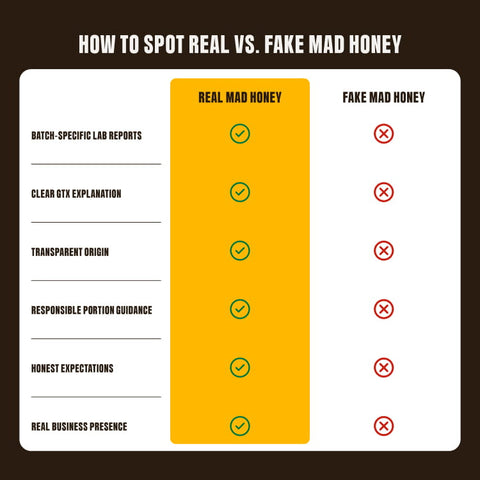
Whenever you’re buying mad honey online, no matter the seller, a few checks help you tell a useful report from a weak one:
- A named laboratory: Ideally an independent one, with contact details you could check.
- A test date: Recent enough to reflect what's currently on sale.
- A clear sample description: Which honey and origin the results apply to.
- Actual values with units: GTX I and GTX III figures, not just "tested" or "passed."
- The full document: A complete report you can download or view, not a cropped screenshot or a badge on a product photo.
Every batch of Real Mad Honey is tested by an independent laboratory for its grayanotoxin content. On our Lab Report page you can look up the report that applies to your order.
Final Thoughts
A mad honey lab report looks technical, but it comes down to a few simple questions: who tested the honey, when they tested it, which honey they tested, and what they found.
GTX I and GTX III are the two grayanotoxins most labs measure, and they're listed separately because they're distinct compounds. The numbers next to them are measurements for that batch, and they naturally vary by rhododendron species, altitude, and season. A "not detected" result simply means a value fell below what the lab could measure.
Once you know what to look for, it's easy to tell a complete, useful report from a vague one.
Label information
Never more than 5 g a day – less than one level teaspoon, for adults only.
Eating more than 5 g a day can cause dizziness, nausea, cold sweats and low blood pressure. If that happens, stop, drink water and rest; if symptoms are severe, call 112 or see a doctor. Not recommended for children, during pregnancy or breastfeeding, for people with heart or blood pressure conditions, or if allergic to honey. Taking medication? Ask your doctor first.