Key Takeaways
- In Europe, mad honey usually costs from around €25 for a small jar to well over €150 for a large one.
- Price per gram is the fairest way to compare sellers, because jar sizes vary so much.
- Origin, harvest method, testing, and where the honey ships from all shape the final price.
- A price close to ordinary honey is a reason to look more closely at what you're buying.
Mad honey is one of the more expensive honeys you can buy. A small jar can cost more than a kilogram of supermarket honey, and the price for what looks like the same product can vary a lot from one seller to the next.
Some of that difference is down to the honey itself: where it comes from, how it's harvested, and how much there is. Some comes down to the seller: jar sizes, testing, and whether the honey ships from inside or outside the EU. This guide explains what drives the price and how to compare offers.
How Much Does Mad Honey Cost?
In Europe, mad honey typically costs from around €25 to €50 for a small jar, while larger jars can go well past €150. Because sellers use very different jar sizes, the headline price doesn't tell you much on its own. Working out the price per gram is the fairest way to compare one offer with another.
What Affects the Price of Mad Honey
There are six main factors contributing to mad honey’s final price.
1. Origin
Mad honey comes from two main regions: the Himalayas in Nepal and the Black Sea coast of Turkey. Each has its own harvest traditions, supply, and route to European buyers, and those differences can show up in the price.
2. How It's Harvested
In Nepal, mad honey comes from the wild cliff nests of the Himalayan giant honeybee. Honey hunters reach the nests with ropes and ladders and cut the comb by hand. It's skilled, slow work that can't be scaled up the way ordinary beekeeping can.
In Turkey, beekeepers along the Black Sea coast and in the Kaçkar Mountains produce deli bal (mad honey). The bees forage on rhododendron in spring, and it's still a small, regional harvest.
3. Harvest Size and Season
Mad honey depends on rhododendrons, which flower for only a short window each year at specific altitudes. A poor season means less honey, and the total amount produced is small compared with everyday varieties like acacia or rapeseed honey. Limited supply keeps prices high.
4. Jar Size
Small jars almost always cost more per gram than large ones. The packaging, labelling and handling cost roughly the same whatever the size, so a 50 g jar carries more of those costs per gram than a 250 g or 500 g jar.
5. Testing and Documentation
Mad honey contains naturally occurring grayanotoxins from rhododendron nectar, and their levels vary from batch to batch. Sellers who have each batch tested by an independent laboratory and who publish the results take on costs that sellers without testing don't. Clear label information and a named origin are also part of what you're paying for.
6. Where It Ships From
Within the EU, goods move between member states without customs charges, so an order from a seller based in the EU usually arrives without extra fees on delivery. Orders from outside the EU can bring import VAT and, depending on the value, customs duties, as well as handling fees from the carrier and longer delivery times. Those extra costs don't always appear in the price on the product page.
Nepali vs. Turkish Mad Honey Prices
There’s no fixed rule that one origin always costs more than the other. A Nepali jar can be cheaper than a Turkish one from a different seller, and the other way round, depending on the harvest, the year, and how each seller prices its range. Some sellers charge the same for both.
Because of that, origin alone isn’t a reliable price guide. When two offers come out close, the choice often comes down to taste instead: Nepali mad honey is typically darker and more bitter, while deli bal is lighter and smoother.
Our comparison of Nepali vs Turkish mad honey covers origin, taste, and harvest in more detail.
How to Compare Mad Honey Prices
A €30 jar isn’t automatically cheaper than a €60 one. It might hold half the honey, come without a lab report, or arrive with import charges on top. These three checks show what you’re really paying for.
Work Out the Price per Gram
Divide the price by the number of grams in the jar. It takes a few seconds and makes offers in different sizes directly comparable. Here's an example with sample prices:
| Jar size | Example price | Price per gram |
|---|---|---|
| 50 g | €40 | €0.80 |
| 250 g | €130 | €0.52 |
| 500 g | €200 | €0.40 |
Add Up the Total Cost
The price on the product page is only part of the picture. Add shipping, and for orders from outside the EU, allow for import VAT, possible customs duties, and carrier handling fees. A cheaper jar from abroad can end up costing more than one shipped from within the EU.
Check What's Included
Before comparing prices, check what each seller actually offers:
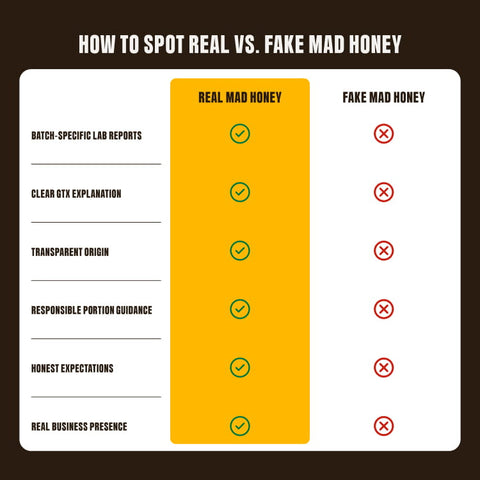
- A named origin: a specific region, not just "Himalayan" or "Turkish"
- Lab reports: published grayanotoxin results for the honey you're buying
- Label information: clear details on the jar and on the product page
- A returns policy: what happens if you're not happy with your order
Why Very Cheap Mad Honey Is a Warning Sign
Mad honey is costly to harvest, test, and ship, so a price close to ordinary honey is worth questioning. It doesn't automatically mean a jar is fake, but it's a reason to look more closely.
Watch out for:
- No lab report, or one you can only get by emailing the seller
- A vague origin with no named region
- No label information on the jar or the product page
- Photos and descriptions that also appear on other sellers' sites
Our guide to buying mad honey online in Europe goes through what to check before you order.
What Mad Honey Costs at Real Mad Honey
At Real Mad Honey, prices start from around €40 for a 50 g jar, with larger jars and bundles available. Nepali mad honey, Turkish deli bal, and the "Try Both" option are all priced the same, so you can choose by taste rather than by price.
Every batch of Real Mad Honey is tested by an independent laboratory for its grayanotoxin content. On our Lab Report page, you can look up the report that applies to your order.
We ship from within the EU. Delivery times per country are on our shipping page.
Final Thoughts
Mad honey costs more than most honeys because of where it comes from and how it's made: small, seasonal harvests from Himalayan cliffs and Black Sea beekeepers. Within that, prices still vary widely between sellers, and the headline price on a jar rarely tells the whole story.
Comparing the price per gram is the quickest way to see which offers are really similar. The total cost matters too, especially once shipping, import VAT, and customs come into it for orders from outside the EU. Finally, look at what the price includes, from a named origin to published lab reports and clear label information. A seller who is open about all three makes it much easier to judge whether the price is fair.
Label information
Never more than 5 g a day – less than one level teaspoon, for adults only.
Eating more than 5 g a day can cause dizziness, nausea, cold sweats and low blood pressure. If that happens, stop, drink water and rest; if symptoms are severe, call 112 or see a doctor. Not recommended for children, during pregnancy or breastfeeding, for people with heart or blood pressure conditions, or if allergic to honey. Taking medication? Ask your doctor first.