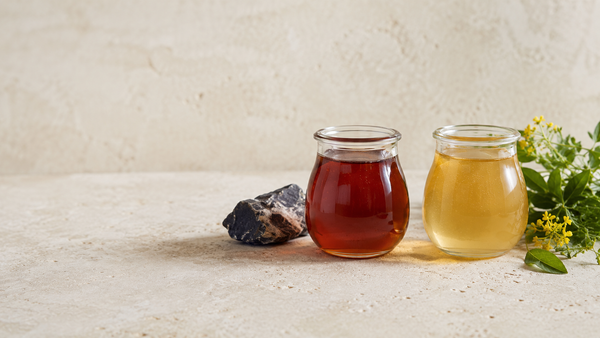
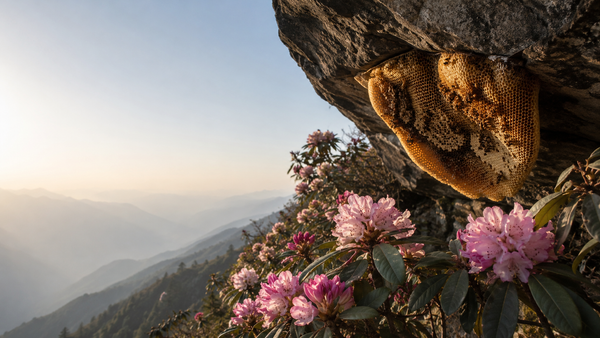
Himalayan mad honey comes from wild colonies built on vertical rock faces above 3,500 meters, reached once or twice a year by people climbing on ropes. There is no farmed version, no managed alternative, and no way to increase what comes down from those cliffs.
That single fact explains almost everything else about it. The rarity, the price, the variation between jars and the reason a season can pass with very little to sell all follow from a harvest that nature limits rather than a producer.
Where Himalayan Mad Honey Comes From
The honey comes from the mountain districts of central Nepal, with Lamjung, Myagdi and the wider Annapurna region among the areas most closely associated with it. Colonies sit on cliff faces at elevations above 3,500 meters, in terrain that no road reaches and no vehicle can service.
Altitude is what makes those places productive. Above 3,000 meters, the plant community thins out sharply, and rhododendrons make up a far larger share of what a foraging colony can reach than they ever would lower down. That concentration is the whole point, since the compounds only reach honey in quantity when bees work those flowers heavily rather than occasionally.
Timing narrows it further. The rhododendrons bloom for a few weeks in April and May, and the honey collected during that window is the strongest of the year, with a smaller autumn harvest sometimes following once the main bloom has finished.

Which Bees and Flowers Make Mad Honey
Neither the bee nor the flower produces mad honey alone, and the Himalayas are one of the few places where both occur together in the right conditions.
Apis laboriosa, the Himalayan giant honey bee, is the largest bee species in the world at close to twice the size of the European honey bee. It builds single enormous combs in the open air beneath cliff overhangs, chooses south-facing rock that holds the day's warmth, and forages at altitudes up to around 4,100 meters. It also cannot be kept, since the species did not evolve to nest in enclosed spaces and abandons any hive it is placed in, which is why the Himalayan harvest has never been farmed and never will be.
The flowers supply everything the bee cannot. Rhododendron arboreum and related high-altitude species produce nectar carrying grayanotoxins, the compounds that separate this honey from every other kind, and those compounds exist in the flower before a bee ever arrives. Grayanotoxins are what separate this honey from every other kind, and what mad honey is and how it differs from ordinary honey covers them in full.
Put the two together, and the arrangement is unusually fragile. One bee species that cannot be relocated, working a narrow band of plants that bloom for a few weeks, on cliffs that happen to sit where both conditions overlap.

How the Honey Is Reached
Reaching a nest means descending to it. Ladders are woven from bamboo and rope and dropped from the cliff top, and one or two harvesters climb down to the comb while a team of ten to fifteen manages the lines above and collects what comes down below.
Smoke is raised from the base of the cliff to move the bees off the comb, and sections are then cut free with long poles and lowered in woven baskets. Nests commonly sit twenty-five meters or more above the valley floor, and a single cliff can occupy a full day.
The work has always been dangerous. Steep drops, unstable rock, unpredictable weather, and hours suspended on rope are the conditions, and for generations hunters worked with hand-twisted ropes, no harnesses, and no protective clothing at all. That is beginning to change, as buyers supply proper equipment before each season, though the fundamental exposure remains what it always was. The tradition behind these harvests is documented in more detail separately.
Who Harvests Mad Honey
Gurung communities in the Nepalese highlands have harvested this honey for generations, and the knowledge involved sits with families rather than with any institution. Reading a cliff, judging weather, knowing which nests are ready and how to work a rope ladder safely are skills passed from one generation to the next by doing the work alongside someone who already knows it.
That transmission is more fragile than it sounds. Traditions in the Himalayas rarely end because people forget them, but because people cannot afford to stay, and when local work pays too little, families send their young abroad for physically demanding jobs under poor conditions. The knowledge leaves with them.
Pay is therefore the practical form that preservation takes. Buyers who pay hunters and local partners above the regional median make staying a financially sensible choice rather than a sentimental one, which keeps skills in the village, keeps income steady across seasons rather than arriving as a single windfall, and circulates money through the wider local economy.
Harvesting Without Damage
Rising demand for a wild product usually means rising extraction, and the obvious worry about Himalayan honey is that the cliffs and the colonies are being worked harder each year.
The practice runs the other way, and the reason is local rather than regulatory. These communities treat the forest as home and inheritance rather than as a resource to strip, and their livelihood depends on the colonies returning. In practice, that means four things:
-
A portion of every comb is left behind so the colony can recover and produce again
-
Collection happens only within the established windows, leaving the bees to rebuild outside them
-
Volume is never increased by forcing extra trips when supply runs short
-
The same local groups do the work rather than new crews brought in to chase scale
Each of those reduces the yield relative to what could be taken, which is the point. Emptying a nest produces more honey this season and less every season afterward, and pushing hunters toward additional collection is exactly how a wild system degrades.
Working through established partners keeps all of it enforceable. A buyer with a long-standing relationship knows where the honey came from, who collected it and how, which makes sustainable practice something that can be verified rather than merely claimed.

Where to Find Genuine Himalayan Honey
Most honey sold as Himalayan never came near a cliff. The word describes a mountain range spanning several countries and commits a seller to nothing, which is why it appears so often on jars with no region, no harvest period, and no figures behind them.
Real Mad Honey sources through the Gurung honey-hunting communities described above, paying above-median rates directly rather than buying through intermediaries, and supplies ropes, harnesses, and protective equipment before each hunting season. The relationship is specific enough that the regions and the hunters are known rather than inferred.
Sourcing establishes where the honey came from. Testing establishes what is in it. Multiple samples are taken from each harvest, an independent laboratory measures GTX I and GTX III, and only batches with confirmed concentrations are accepted, with anything inconsistent refused rather than blended into the next one. Those reports are published for the batch on sale rather than summarized.
The result is a jar whose origin can be named and whose contents can be read, which is more than the word Himalayan could ever guarantee on its own.
Verdict: What Rarity Actually Costs
Himalayan mad honey is rare for reasons that cannot be engineered away. One bee species that will not accept a hive, a flowering window measured in weeks, cliffs reachable only on foot and rope, and communities small enough that the skill itself is at risk.
Some of that scarcity is chosen rather than imposed. Leaving comb for the colonies and refusing to force extra collection reduces what reaches a jar, and a seller doing neither could produce more honey in the short term at a cost the cliffs would eventually pay.
What that leaves a buyer with is a product where the constraints are the point. The limited supply, the variation between harvests, and the price all trace back to the same source, which is a honey that exists only where people are willing to climb for it and restrained enough not to take it all.