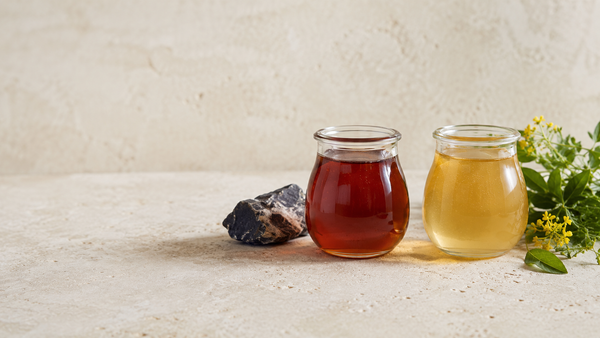
Mad honey is made the way all honey is made, by bees converting flower nectar into honey inside the comb. What separates it is the flower. When colonies work rhododendrons that carry grayanotoxins, those compounds travel into the honey with the nectar and stay there.
Everything after that is collection rather than production. Nothing is added at any stage, and no part of the process can make a batch stronger than the flowers made it, which is why this is better described as a harvest than a manufacturing chain.

How Mad Honey Is Made
The work happens inside the colony. Foragers collect rhododendron nectar and carry it back to the comb, where it passes between workers whose enzymes break the complex sugars into simpler ones. The colony then fans the comb to drive off moisture until the water content drops low enough for the honey to keep indefinitely, at which point the cells are capped with wax.
The grayanotoxins ride along untouched. They exist in the nectar of certain rhododendron species before a bee ever reaches the flower, and neither the enzymes nor the evaporation alters them, so the concentration in the finished honey reflects what the colony collected rather than anything that happened in the hive. The chemistry of those compounds is covered in what mad honey is and where its compounds come from.
How much ends up in the comb depends on how much of the colony's forage came from the right plants. A hillside where rhododendrons dominate the bloom produces honey saturated with the compounds. The same species scattered among competing flowers produces honey with traces of them and no noticeable effect.

How Mad Honey Is Harvested
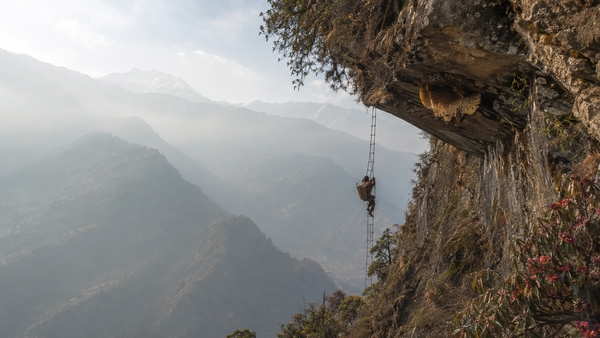
Harvesting begins with locating active colonies, which in Nepal means wild nests built beneath overhangs on vertical cliff faces rather than hives that can be opened on a bench. The colonies cannot be moved, relocated, or kept, so every harvest happens where the bees chose to build.
The work is done by teams of ten to fifteen people during the flowering window, mainly across April and May with a smaller collection sometimes following in autumn. Ladders are woven from bamboo and rope and dropped from the cliff top, and one or two harvesters descend to the nest while the rest manage the lines from above and collect below. Smoke is raised from the base of the cliff to move the bees off the comb, and in Gurung and Kulung communities it carries ceremonial weight as well as practical use.
Sections of comb are cut free with long poles and lowered in woven baskets to the ground. Nests commonly sit twenty-five meters or more above the valley floor, and a single cliff can take a full day. Historically, the work was done on hand-twisted ropes with no harnesses or protective clothing at all, though some buyers now supply proper ropes, harnesses, and protective gear to the communities they source from ahead of each season. The tradition behind these harvests has passed through the same families for generations.
Turkish harvesting looks nothing like this. Beekeepers move managed hives into Black Sea meadows while the rhododendrons flower and collect frames conventionally, which is small-scale pastoral beekeeping rather than honey hunting.
What Happens After the Harvest
Comb reaches the village as raw material rather than as honey. It arrives full of wax, pollen, brood in places, and fragments of whatever came away from the cliff with it, and separating the honey from all of that is the next stage.
Traditional processing is simple and mostly manual. The comb is crushed or pressed by hand and the honey allowed to drain through cloth or fine mesh, which removes wax and debris without heating anything. Warming the honey would speed the process considerably and is standard in commercial honey production, though it is avoided here because heat alters flavor and aroma and its effect on grayanotoxin content is not well established.
The strained honey then settles. Air bubbles and fine particles rise over a period of days and are skimmed off, leaving the honey clearer without filtering out the pollen that carries its botanical identity. What comes out at the end is unpasteurized and unblended, which is why one batch looks and tastes different from the next.
Testing and Quality Control
Sampling happens before a batch is accepted rather than after it is sold. A sample goes to an independent laboratory, where liquid chromatography and mass spectrometry measure how much GTX I and GTX III the honey actually contains, reported as figures for that specific batch.
Those figures decide what happens next. A batch within the expected range is accepted and its report published alongside it. One that falls outside, whether too weak to be worth selling or inconsistent with the harvest it came from, is rejected rather than blended into a stronger batch to bring the average up. Blending would produce steadier stock and would also destroy the thing being sold.
The reason this stage matters more here than in most food production is that nothing observable substitutes for it. Color, thickness, and bitterness all vary for reasons unrelated to grayanotoxin content, so the laboratory figure is the only description of a batch that means anything.
Packing and Storage
Honey is jarred once testing clears it, in sealed containers that protect it from moisture and air. Glass and lined bamboo are both used, and the seal matters more than the material, since honey absorbs water from humid air and a loose lid will degrade a jar faster than anything else.
Storage is undemanding. Honey kept sealed at room temperature, away from direct sunlight and heat sources, holds its character for years, and grayanotoxins are stable compounds that are not thought to break down appreciably in ordinary conditions. Refrigeration is unnecessary and encourages crystallization.
Crystallization itself is worth expecting. Raw honey granulates over time as glucose comes out of solution, faster in some batches than others depending on the sugar balance and the temperature it is kept at. A crystallized jar is neither spoiled nor weaker, and gentle warming returns it to a liquid state, though strong heat should be avoided for the same reasons it is avoided during processing.
Why Production Is Limited
Every stage of this process has a ceiling that money cannot raise. The number of accessible cliffs is fixed by geography, the flowering window lasts a few weeks, and the colonies are wild ones that cannot be established, relocated, or multiplied to meet demand.
The people are the tightest constraint of all. Cliff harvesting is dangerous, physically punishing work that takes years to learn, and the communities that still practice it are smaller with each generation as younger people move toward cities and steadier employment. No amount of investment produces more honey hunters.
Weather sets the ceiling lower still in bad years. A cold spring delays flowering, rain during the bloom cuts the hours bees can forage, and a poor season yields less honey and weaker honey at the same time, with no way to make up the shortfall before the following spring.

Buying Mad Honey From a Real Harvest
A seller working from actual harvests can describe them specifically, naming the region and the community the honey came from and producing the figures for the batch being sold. One buying through bulk intermediaries usually cannot, which is why vague sourcing language and a single laboratory result reused indefinitely tend to appear together.
Real Mad Honey sources directly rather than through middlemen. Nepalese honey is wild-harvested above 3,500 meters by Gurung honey-hunting communities the company works with year after year, and Turkish honey comes from small family producers in the Black Sea region who have made it for generations.
Testing covers every harvest. Multiple samples are taken, an independent laboratory runs the analysis, and only batches with confirmed grayanotoxin concentrations are accepted, with anything inconsistent refused rather than bought and blended into stock. That standard costs the seller volume rather than the customer.
Every batch then has its own published report, so the GTX I and GTX III figures for the honey being bought can be checked before ordering rather than taken on trust.
Takeaway: What the Process Actually Guarantees
The chain from flower to jar is remarkably short. Bees convert nectar in the comb, hunters cut the comb from a cliff, the honey is pressed and strained by hand, and it goes into a jar. No stage in between adds, removes, or adjusts anything.
That is the appeal for anyone who wants a food that has not been engineered, and it is also why two jars are never quite alike. A wild harvest cannot be tuned toward a house style the way blended honey can, so what a buyer receives reflects one hillside in one season rather than a recipe.
Understanding the process is what makes those figures readable. Knowing that nothing is added, that heat is avoided, and that weak batches are rejected rather than blended tells a buyer what a laboratory report is actually measuring, and why a number attached to one batch says nothing about the next