Mad honey is sold in two types, Nepalese and Turkish, and those are what most sellers mean when they ask a buyer to choose. The word covers a difference in origin rather than anything bred or cultivated, since nobody selects or propagates mad honey the way growers do with crops.
What that leaves is a genuine choice between two regions with different bees, different flowers, and noticeably different honey, sitting on top of a much larger amount of variation that no label captures at all.
Are There Different Mad Honey Strains?
Two types are sold, and the distinction between them is real. Nepalese honey comes from wild colonies on Himalayan cliffs, Turkish honey from managed hives along the Black Sea coast, and the two differ in appearance, taste, and effect in ways anyone who has tried both would recognize.
Calling them strains is borrowed language, and slightly misleading. A cultivated variety is bred for consistent characteristics, which is what makes the term useful for apples, grapes, or coffee. Nothing comparable happens here, since mad honey comes from wild plants worked by bees that nobody directs, and the same hillside produces different honey from one year to the next.
The more accurate way to think about it is by origin, and then by harvest within that origin. Which country the honey came from sets a broad expectation of character. Which specific collection it came from determines nearly everything else.

Nepalese Mad Honey
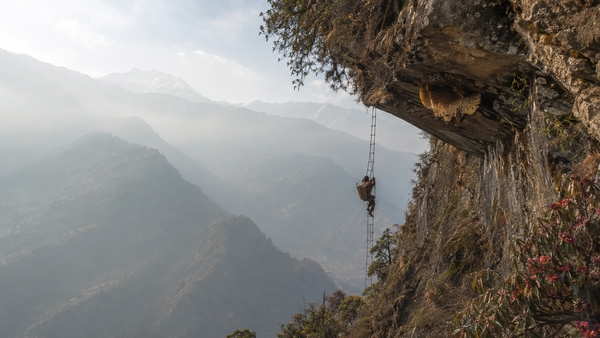
Nepalese honey comes from the mountain districts of central Nepal, with Lamjung, Myagdi and the wider Annapurna region among the areas most closely associated with it. Colonies build on cliff faces at elevations above 3,000 meters, in terrain no road reaches and no vehicle can service, which means the honey has to be climbed for.
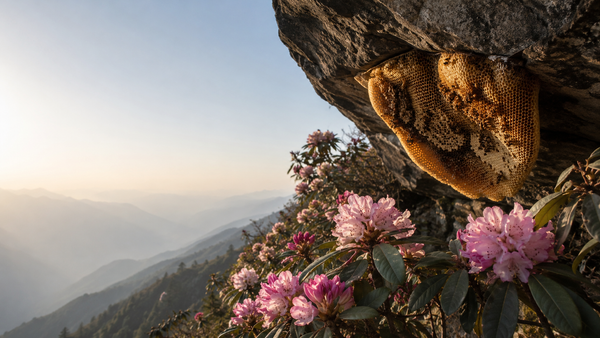
Altitude is what makes those places productive. Above 3,000 meters, the surrounding plant community thins out sharply, so rhododendrons make up far more of what a foraging colony can reach than they would lower down, and the compounds only concentrate when bees work those flowers heavily rather than occasionally.
The bee is Apis laboriosa, the largest honey bee in the world at close to twice the size of the European honey bee. It builds single open combs beneath rock overhangs and cannot be kept in hives, since the species abandons any enclosed structure it is placed in. Every harvest therefore means a team of ten to fifteen people, bamboo ladders dropped from a clifftop, and one or two of them descending to cut comb free by hand.
That method sets the supply. Collection happens once or twice a year at most, and a single cliff can occupy a full day, so the number of accessible nests is fixed by geography rather than by demand. A batch that sells through often has nothing comparable behind it until the following spring. More on where mad honey comes from and how it is harvested is available separately.

Turkish Mad Honey
Turkish honey comes from the humid forested slopes along the Black Sea coast, particularly through the Kaçkar range and the provinces around Rize and Trabzon. The climate there is unusually wet for the region, which is precisely what the relevant plants need to spread.
Rhododendron ponticum and Rhododendron luteum grow across those slopes in dense, continuous stands rather than scattered through mixed forest, and during the flowering period they dominate most of what else is in bloom. That density does the same job altitude does in Nepal, concentrating the bees' forage onto the plants that matter.
The method is entirely different. Beekeepers move managed Apis mellifera hives up into high meadows while the bloom lasts and collect frames conventionally, which makes this small-scale pastoral beekeeping rather than honey hunting. The hives can be moved, though the rhododendron stands cannot, so a beekeeper places colonies near what is already established and already flowering.
Supply follows from that. The flowering window runs longer, the hives are reachable on foot rather than on rope, and the honey is correspondingly easier to obtain across the year. It is known locally as deli bal, and it is the origin most people encounter first.
Nepalese and Turkish Mad Honey Compared
Two very different places and two very different ways of working produce two noticeably different honeys. What matters to anyone choosing between them is narrower than the geography, and comes down to what ends up in the jar.
| Nepalese | Turkish | |
|---|---|---|
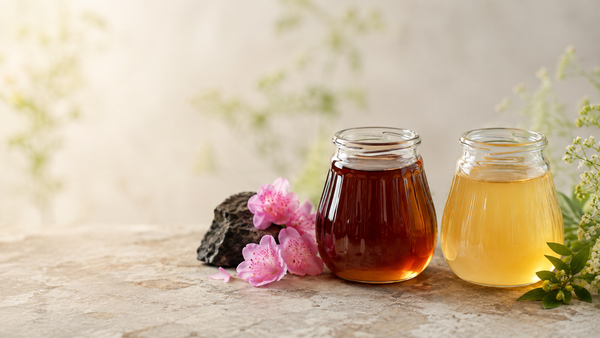
| Color | Deep amber to reddish brown | Pale gold to light amber |
| Texture | Thick, crystallizes readily | Looser and more pourable |
| Aroma and taste | Earthy, resinous, bitter finish | Floral, sweet first, mild after |
| Typical strength | Higher on average | Lower on average |
The tasting notes follow directly from where each honey grew. Himalayan colonies work rhododendrons in a sparse alpine landscape where little else competes, which concentrates both the compounds and the resinous, bitter character that comes with them. Turkish hives sit among a richer coastal mix, and the honey arrives lighter in every sense, from the color in the jar to the finish on the spoon.
Neither column describes a particular jar. These are averages drawn from many harvests, and a strong Turkish collection can carry more than a weak Nepalese one.
Why Two Jars of the Same Origin Differ
Origin turns out to be the smaller of the two variables at work. Two Nepalese jars from different valleys or different seasons can sit further apart in strength and character than the averages for Nepal and Turkey sit from each other, which means the country on the label describes a range rather than a point within it.
What decides where a jar falls within that range is the harvest itself. Grayanotoxin concentration depends on which rhododendrons dominated the forage, how densely they flowered, the elevation of the particular colony, and the weather across that season, none of which is consistent from one collection to the next even within a few kilometers.
Testing is what closes the gap. A published figure for GTX I and GTX III describes the jar being bought rather than the category it belongs to, and what mad honey is and how its composition varies explains why those figures move so much between harvests.
Does the Season Change the Honey?
Collection date matters as much as country. The main Himalayan harvest falls in April and May, when the rhododendrons are at full bloom and dominate the forage almost completely, and that spring collection produces the strongest honey of the year.
A smaller autumn harvest sometimes follows in October and November. By then the rhododendrons have finished, and the colonies have been working a broader mix of whatever else is flowering, so the honey is lighter in character and milder in effect while remaining genuine.
Turkish flowering runs later, through late spring into early summer, which gives that origin a longer collection window and steadier supply across the year.

Buy Mad Honey by Origin
Buying by origin works as a starting point rather than as a specification. Turkish honey suits a first purchase, since the lighter profile and gentler effect make a serving easier to judge, while Nepalese honey delivers the fuller character that the category is known for.
Real Mad Honey carries both. Nepalese honey is wild-harvested above 3,500 meters through Gurung honey-hunting communities, and Turkish honey comes from small family producers along the Black Sea who have made it for generations.
Every batch is analyzed by an independent laboratory for GTX I and GTX III before sale, with the report published for the batch on the shelf, and batches falling outside the accepted standards are rejected rather than blended into the next one. That means the origin can be chosen for character while the figures settle strength, which is the only combination that answers both questions.
Both origins come in the same range of sizes, from 50g up to 500g, which matters more than it sounds for a decision like this one. A small jar of each costs less than committing to one and finding out afterward, and tasting them side by side settles in an evening what no amount of reading about character can.
Conclusion: What the Two Strains Really Mean
Two strains exist, and what they really describe is a choice of character rather than a specification. Nepalese honey is darker, heavier, and generally stronger, while Turkish honey is lighter and gentler, which is why the Turkish jar is usually the better place to begin.
What separates the two is fixed before the bees start work, which is the limit of what the distinction can tell anyone. A country, a bee species, and a broad style are settled in advance, while the things deciding how a particular jar behaves are settled afterward by the colony's location, the weather that season, and the date of collection. Two jars sharing a name can therefore differ more than the two names differ from each other.
The practical reading is that origin narrows the field, and the report closes it. Naming a strain selects the kind of honey wanted, dark and resinous or pale and floral, and the published figures for that batch confirm what actually arrived in the jar. Neither answers the other's question, which is why both are worth having.