Mad honey comes from two places: the Himalayan belt through Nepal and the Black Sea coast of Turkey. Those are the only regions producing it at any commercial scale, and between them they supply every genuine jar sold anywhere in the world.
The two could hardly be less alike. One involves wild colonies on vertical cliff faces at altitudes above 3,000 meters, the other managed hives in coastal mountain meadows, and the honey each produces reflects that difference in color, flavor and strength.
The Two Regions That Produce Mad Honey
Nepal and Turkey account for effectively all of it, for reasons that come down to where the right plants grow densely enough to dominate what a bee colony collects. Grayanotoxins reach honey only when bees work certain rhododendrons heavily rather than incidentally, which requires those species to crowd out most of the competing bloom across a whole foraging range.
Grayanotoxin-bearing plants do grow more widely than that. Related species appear in Bhutan, India and southern China, in Japan and Korea, and across parts of the United States and Canada. None of those countries produces mad honey commercially, because scattered plants in a mixed landscape leave honey with traces of the compounds and no noticeable effect.
Density, in other words, is the condition that narrows the map. Two regions happen to satisfy it, and everything sold as mad honey traces back to one of them.

Nepal: The Himalayan Belt
Nepalese mad honey comes from the mountain districts of the country's central belt, with Lamjung, Myagdi and the wider Annapurna region among the areas most associated with it. Colonies sit between roughly 2,500 and 3,500 meters, and the bees forage higher still, up to around 4,100 meters.
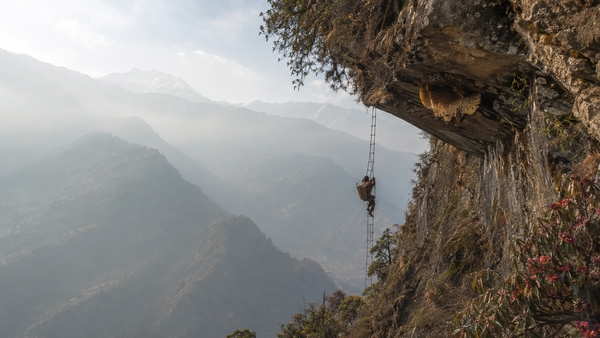
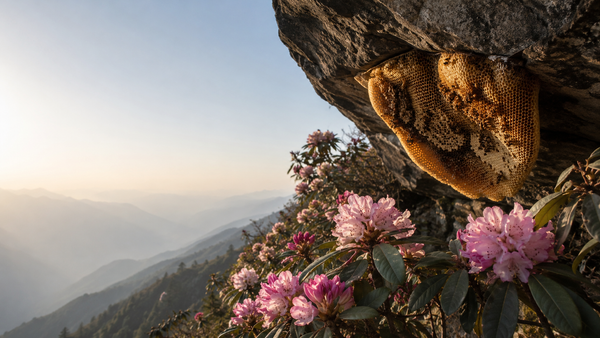
The bee is what defines the region's honey. Apis laboriosa, the Himalayan giant honey bee, is the largest in the world at close to twice the size of the European honey bee, and it builds single enormous combs in the open air beneath cliff overhangs. It cannot be kept in hives, since the species did not evolve to nest in enclosed spaces and abandons any structure it is placed in, which means every Nepalese harvest begins with someone climbing to reach a wild colony.
Rhododendron arboreum is the species most linked to the honey, though pollen studies consistently find Nepalese samples to be multifloral, with rhododendron dominant in many but rarely alone. A closer account of how these harvests actually work covers the cliff-harvesting tradition in more depth.

Turkey: The Black Sea Coast
Turkish mad honey comes from the humid forested slopes along the Black Sea, particularly through the Kaçkar range and the provinces around Rize and Trabzon. The climate there is unusually wet for the region, which is exactly what the relevant plants need.
Rhododendron ponticum and Rhododendron luteum grow across those slopes in continuous stands, often dominating whatever else is in bloom. Beekeepers move managed Apis mellifera hives into high meadows during the flowering period, which makes this small-scale pastoral beekeeping rather than honey hunting. The honey is known locally as deli bal.
The hives can be moved, but the plants cannot, and that limits the Turkish supply as firmly as the cliffs limit the Nepalese one. A beekeeper can only place colonies near stands that are already established and already flowering, and rhododendrons take years to spread across a slope.
Nepal vs Turkey
The differences run through every stage, from the bee to the finished jar.
| Nepal | Turkey | |
|---|---|---|
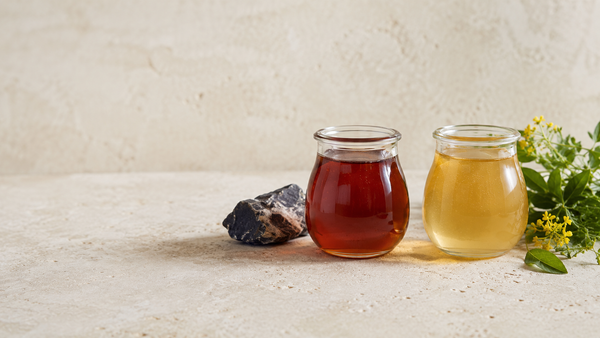
| Appearance | Deep amber to reddish brown | Pale gold to light amber |
| Texture | Thicker, often crystallizing over time | Looser and more pourable |
| Aroma | Earthy and resinous | Floral and faintly herbal |
| Taste | Bitter finish, lingering warmth in the throat | Sweet first, mild bitterness afterward |
| Effect | Fuller and heavier | Gentler and more even |
| Availability | Two short harvests, frequently limited | Longer summer window, steadier supply |
Those differences trace back to altitude and competition. Himalayan colonies work rhododendrons that dominate a sparse alpine landscape, which concentrates both the compounds and the resinous character that comes with them, while Turkish hives sit among a richer coastal mix that dilutes both. The heavier Nepalese profile is the direct result of a harsher place to grow.
Neither column is a guarantee. A strong Turkish harvest can outperform a mild Nepalese one, because both vary by season, altitude, and flowering conditions. Origin sets an expectation of character, while the individual batch decides the strength.
When Mad Honey Is Harvested
A few weeks of flowering produce a year's supply. The main Himalayan collection falls in April and May, when the rhododendrons are in full bloom, and the honey reaches its strongest, with a smaller secondary harvest sometimes following in October and November. Turkish flowering runs through late spring into early summer, with its own narrow window.
Weather compresses both further. A cold spring delays flowering, heavy rain during the bloom cuts the hours bees can forage, and a poor season yields less honey and weaker honey at once. None of it can be made up afterward, since the flowers are finished either way.
Volume is fixed by geography rather than by planning. A wild cliff colony produces what it produces, the number of colonies within reach of a harvesting team does not change, and everything sold between one spring and the next comes out of what was collected during those weeks.
Why Every Harvest Is Different
Each batch is a specific collection from a specific season, which makes consistency the wrong expectation to bring to this product. Grayanotoxin concentration depends on which rhododendrons dominated the forage, how densely they flowered, the elevation of the colony, and the weather across the season, and changing any of those changes the honey.
Two harvests from neighboring valleys in the same spring can differ in color, flavor, and strength, and the same valley in two different years can produce noticeably different jars. The chemistry behind that sits in what mad honey is and where its compounds come from.
Ordinary honey solves this by blending. Supermarket jars combine honey from many sources to hit a consistent profile, which is legitimate and the reason one brand tastes the same all year. Mad honey treated that way would lose what it is bought for, since blending a strong harvest into a weak one produces a uniform middle rather than a good jar. The alternative is to leave each harvest intact and measure it.

Where to Buy Nepalese and Turkish Mad Honey
Both origins are sold online rather than in shops, and the practical question is which one to start with rather than where to look.
Turkish honey suits a first purchase. The lighter profile and gentler effect make it easier to judge a serving, and the milder bitterness is less of a shock on the spoon. Nepalese honey rewards anyone who already knows they like the category, since it delivers the fuller, heavier character the reputation is built on, and it is the one most people mean when they talk about mad honey.
Either origin is taken the same way, a teaspoon at a time rather than by the spoonful, which makes even a small jar last considerably longer than its size suggests.
Real Mad Honey carries both, with each batch analyzed by Eurofins for GTX I and GTX III and the report published for the jar on the shelf, so the choice between origins can be made on character while the figures cover strength. Jars run from 50g to 500g, orders ship from the Netherlands with no customs within the EU, and a 60-day guarantee covers unopened returns.
Verdict: What Origin Really Tells a Buyer
Two regions, two bee species and two entirely separate traditions produce every jar of mad honey in existence. Those facts explain the character of a jar reliably enough to choose between origins, with Nepalese honey running darker and stronger and Turkish honey lighter and gentler.
What they cannot explain is any individual batch. A product gathered from wild colonies during a few weeks each spring cannot be standardized without being altered, which means variation between jars is evidence of authenticity rather than a defect in it.
Origin is therefore worth knowing and worth choosing between. What settles the question of a particular jar is the batch report behind it, which is the one thing a wild harvest cannot supply on its own.